



Florida’s 9/11 Response: The Critical Role of Law Enforcement
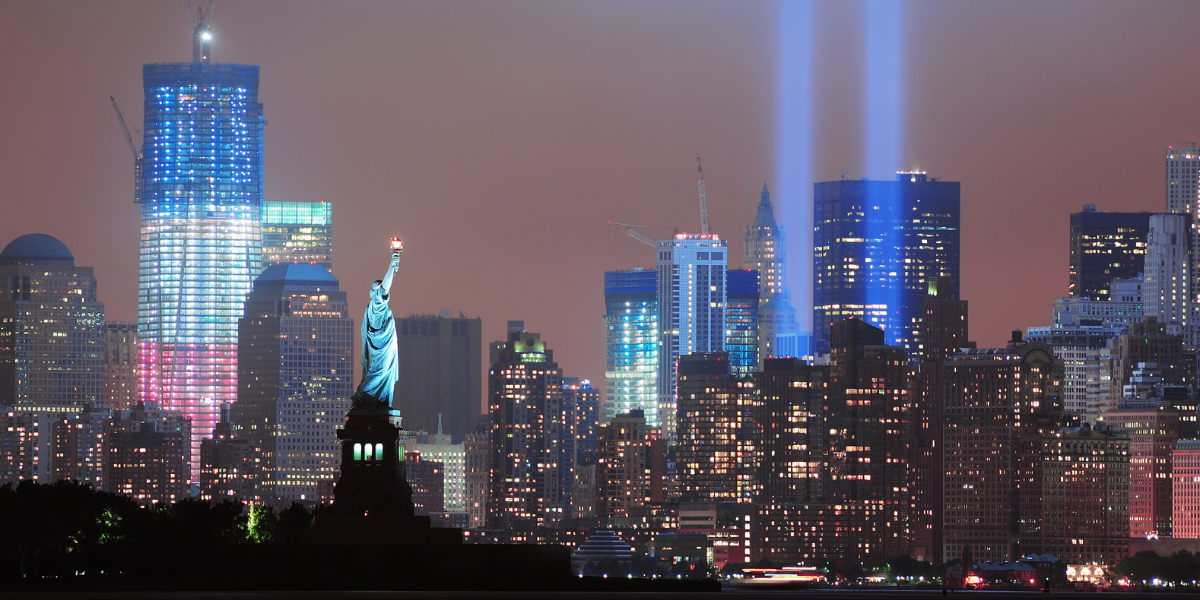
September 11, 2001, remains the deadliest day in U.S. law enforcement history. Seventy-two law enforcement officers were killed while responding to the terrorist attacks on the World Trade Center in New York City. When most Americans think of that day, they picture New York City, the Pentagon and a field near Shanksville, Pennsylvania. Fewer think of Florida. But the Sunshine State holds a pivotal — and deeply sobering — place in the story of the deadliest terrorist attack ever carried out on American soil. Florida was not just a bystander. It was a staging ground, a crisis management center and, ultimately, the birthplace of the nation’s first comprehensive state counterterrorism strategy. At the center of that response stood Florida’s sheriffs.
A Nation Under Attack
On the morning of September 11, 2001, President George W. Bush was in Florida, visiting Emma E. Booker Elementary School in Sarasota to highlight the importance of reading education. As he sat with a classroom of second-grade students during a reading lesson, his chief of staff quietly informed him that a second airplane had struck the World Trade Center, confirming that the United States was under attack. In a moment that would become one of the most recognizable images of that day, President Bush remained with the students for several minutes, seeking to avoid causing panic while gathering more information before addressing the nation. The visit underscored Florida’s unique place in the events of 9/11. Long before the attacks reshaped the country, the state became the backdrop for one of the defining moments in American history, linking a quiet elementary school classroom to a day that would forever change the nation.
Before 9/11: The Florida Timeline
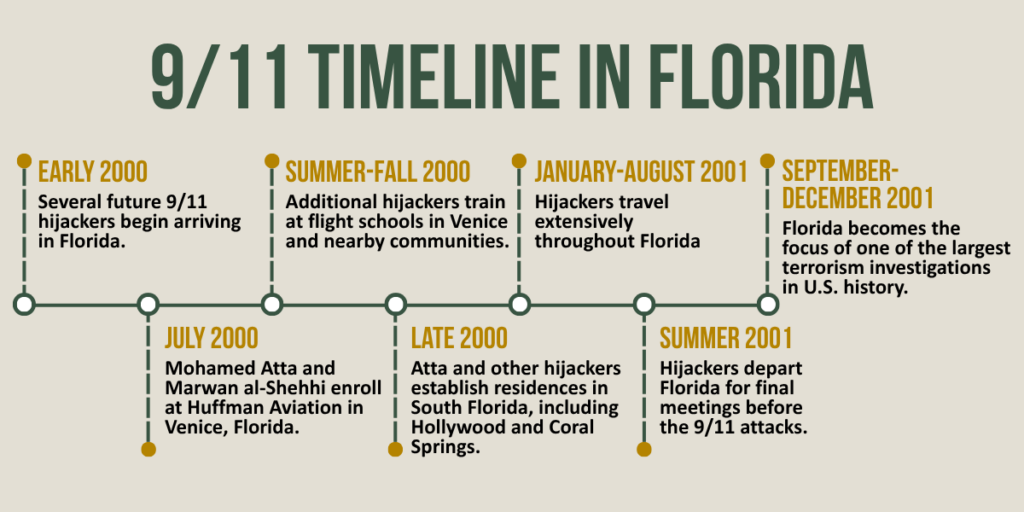
Long before the attacks unfolded, Florida played an unwitting role in their planning. According to the 9/11 Commission, the first hijackers arrived in the United States in January 2000, settling in California. Three hijacker-pilots from the Hamburg cell — Mohamed Atta, Marwan al-Shehhi, and Ziad Jarrah — arrived in Florida in mid-2000 to begin flight training at Huffman Aviation in Venice. Jarrah trained separately at the nearby Florida Flight Training Center, continuing his coursework there into early 2001. Atta and al-Shehhi each paid approximately $10,000 for two months of flight instruction, and the FAA issued Jarrah a private pilot certificate in July 2000. The men moved through the community largely undetected, blending in among the many international students who pursued pilot certificates in Florida each year.
These were not casual students. Atta, the operational leader of the plot, would pilot American Airlines Flight 11 into the North Tower of the World Trade Center. Al-Shehhi would fly United Airlines Flight 175 into the South Tower. Jarrah would take the controls of United Airlines Flight 93, which crashed in a Pennsylvania field after passengers fought back against the hijackers.
Over the following months, additional hijackers arrived at flight schools in Venice and surrounding communities, while the pilots themselves went further to prepare for the attacks. Atta and al-Shehhi trained on commercial aircraft simulators in Opa-locka, where they specifically requested instruction on executing turns and approaches, and nothing more. Investigators would later point to the narrow scope of that request as an early, overlooked warning sign. Around the same period, the men opened local bank accounts and enrolled in self-defense classes at area gyms, likely to stay physically prepared for the attacks, according to the 9/11 Commission’s later assessment.
By late 2000, Atta had settled into South Florida life, renting an apartment in Coral Springs and another in Hollywood, in a building since demolished. Blending into these communities gave the hijackers a base of operations largely removed from scrutiny. That anonymity wasn’t absolute, however: a Broward County sheriff’s deputy pulled Atta over in May 2001 for driving without a valid license, a routine traffic stop that, in hindsight, placed him directly in contact with Florida law enforcement four months before the attacks.
Throughout the first eight months of 2001, the hijackers moved extensively across the state to secure the documentation and legal status the plot required. Several obtained Florida identification cards during this period, and Atta’s own application to shift his immigration status from tourist to student was approved that July, formalizing the cover he had used for nearly a year. As summer 2001 ended, the hijackers began departing Florida for final coordination meetings.
Florida’s 9/11 Response: The Investigation
Florida’s 9/11 response began in the immediate aftermath of the terrorist attacks, as Florida became the focus of the investigation that followed. From September through December 2001, the state was at the center of one of the largest terrorism investigations in U.S. history, as federal, state, and local law enforcement worked to trace the hijackers’ movements, contacts, and financial dealings across Florida communities.
For deputies, agents, and investigators, the work was deeply personal. They retraced the steps of men who had rented apartments down the street, trained at familiar airfields, and walked through the same neighborhoods they patrolled every day. Many had never imagined their own communities would become the epicenter of a terrorism investigation. The experience marked a turning point for Florida’s sheriffs, one that would reshape the mission for the next 25 years.
Florida’s First Responders Answer the Call
Florida’s 9/11 response extended well beyond state lines. In the days following the attacks, first responders from across Florida made their way to New York to join the search and rescue effort at Ground Zero, including members of Florida’s Urban Search and Rescue Task Force-1, who worked alongside firefighters, engineers, and rescue specialists from across the country to search the wreckage of the World Trade Center for survivors and assist in the recovery efforts. Many went not because they were asked to, but because they felt a duty to stand alongside the responders already on the ground.
25 Years Later: A Deputy Remembers
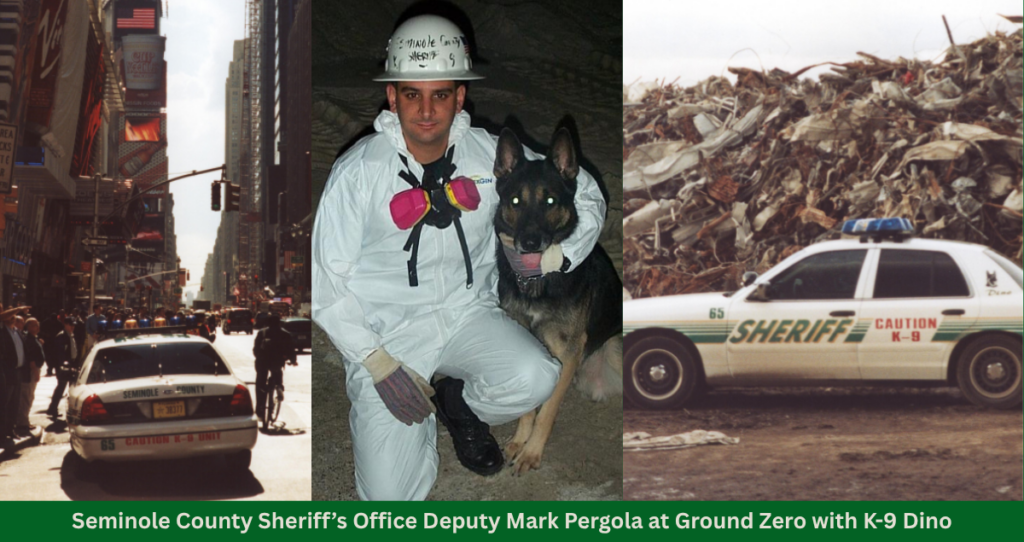
When America came under attack on September 11, 2001, then-Deputy Mark Pergola was working the night shift at the Seminole County Sheriff’s Office. Like millions of Americans, he watched in disbelief as the events unfolded, but when the second plane struck the World Trade Center, he knew the nation was under attack. In the days that followed, Deputy Pergola and his cadaver K-9 partner, Dino, were deployed to New York City as part of a nationwide response effort. They spent five days at the Fresh Kills Landfill on Staten Island, assisting in the careful search and recovery of human remains from debris transported from Ground Zero.
Working alongside hundreds of first responders from across the country, Deputy Pergola and Dino contributed to a mission driven by dignity, respect, and a shared commitment to bring closure to grieving families. The work was both physically demanding and emotionally taxing, but it reflected the unity and resilience of those who answered the call. On his final day, Deputy Pergola assisted the New York City Police Department during a funeral service at St. Patrick’s Cathedral, standing in tribute to fallen heroes and in support of a grieving city.
Twenty-five years later, Captain Mark Pergola reflects on the experience as one of the most meaningful moments of his career. He credits it with strengthening his commitment to public service and reinforcing the importance of teamwork, preparedness, and compassion in law enforcement. As the Seminole County Sheriff’s Office joins the nation in remembrance, Captain Pergola hopes future generations will never forget the sacrifices made and will remain vigilant in protecting their communities.
Florida Leads the Nation
Within 72 hours of the attacks, Florida’s government was already moving with urgency. On September 14, 2001, Governor Jeb Bush formally directed the Florida Department of Law Enforcement (FDLE) and the Florida Division of Emergency Management to conduct an immediate, comprehensive assessment of the state’s capability to prevent, mitigate, and respond to a terrorist attack. FDLE was designated the lead agency for crisis management. The governor directed agencies to examine training programs, equipment, and execution protocols with a sharp focus on prevention.
The result was historic. Florida’s counterterrorism strategy, formally released in October 2001, became the first comprehensive state-level counterterrorism strategy published in the nation — and the first submitted to Governor Tom Ridge upon his appointment as Homeland Security Advisor to President Bush. Florida did not wait for a federal playbook — it wrote its own.
In the years immediately following the attacks, FDLE reports that Florida invested more than $112 million in state and federal funding for domestic security initiatives. The state’s strategy became a model studied by other states and federal agencies.
Florida Sheriffs Step Into a Leadership Role
The most enduring structural legacy of September 11 in Florida is the formal partnership between FDLE and Florida’s sheriffs. Following the attacks, FDLE assumed responsibility as the state’s domestic security coordinator and partnered with Florida sheriffs to establish and lead seven Regional Domestic Security Task Forces (RDSTF), one for each of the state’s FDLE regional operation areas.
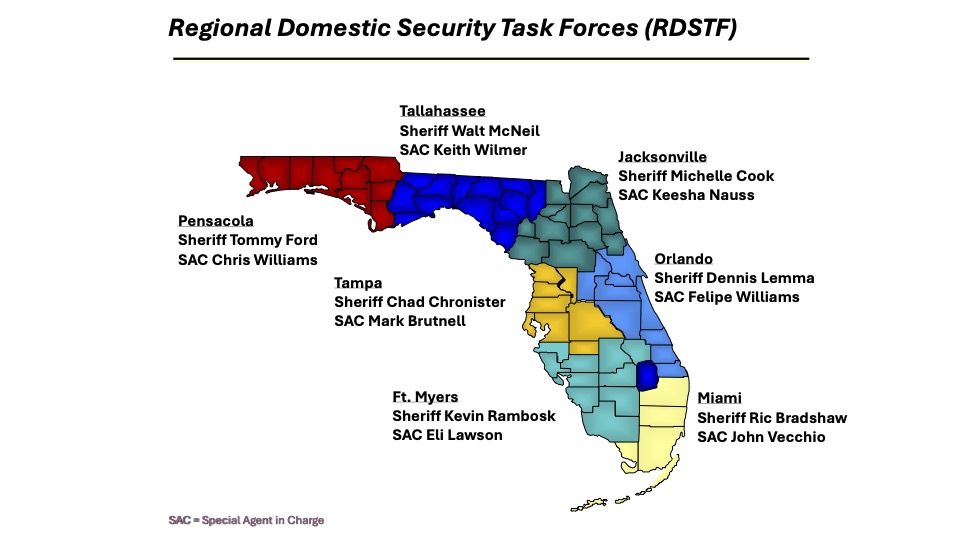
These task forces are not advisory bodies. They are operational, multidisciplinary teams built for real-world response. Each RDSTF is co-chaired by a local sheriff or police chief alongside an FDLE Special Agent in Charge. Membership spans first responders from fire/rescue, emergency management, public health and hospitals, and law enforcement, and extends further to include schools, businesses, and private industries. The task forces serve as force multipliers, enabling local agencies to coordinate resources, share intelligence, and respond to threats at a scale no single agency could manage alone.
This structure placed Florida’s elected sheriffs — constitutionally rooted, community-trusted leaders — at the very center of the state’s homeland security architecture. That was not an accident. Sheriffs are uniquely positioned to bridge the gap between federal intelligence and local community relationships. Their constitutional independence and direct accountability to the citizens they serve make them natural leaders in a framework that depends on public trust and local knowledge.
Legislative Changes Strengthened Sheriffs’ Authority
The Florida Legislature moved quickly to remove barriers that had previously limited sheriffs’ operational flexibility in crisis situations. Among the most practical changes: new state law allowed sheriffs to deploy special deputies in response to acts of terrorism without those deputies having to be bonded, as was normally required. In a rapidly evolving threat environment, the ability to expand a sworn force quickly and without administrative delays is not a minor procedural matter — it is operationally significant.
Legislators also updated Florida’s communication interception statutes to align with federal provisions enacted as part of the post-9/11 national security framework, ensuring that Florida law enforcement had the legal tools necessary to conduct investigations consistent with federal counterterrorism authorities.
A Lasting Commitment to Vigilance
The counterterrorism infrastructure built in Florida after September 11 was not a temporary measure. It has deepened and expanded in the decades since.
In 2017, the Florida Legislature passed House Bill 457, criminalizing a range of terrorism-related activities and appropriating funding for 46 new full-time positions to establish counterterrorism squads in each of FDLE’s seven regions. Those squads work to enhance domestic security through increased intelligence collection and sharing, and through expanded participation in the FBI’s Joint Terrorism Task Forces (JTTF) — multiagency bodies that bring together federal, state, and local law enforcement under a unified investigative framework.
Florida’s sheriffs’ offices are active, standing members of these task forces, working alongside the Federal Bureau of Investigation (FBI), Florida Department of Law Enforcement (FDLE), U.S. Customs and Border Protection, the Naval Criminal Investigative Service, and other federal partners across every region of the state. When a terrorism-related threat surfaces in a Florida community, it is local deputies and detectives — people who know the community, its geography, and its people — who are often best positioned to act.
What 9/11 Revealed and Changed About the Sheriffs’ Mission
The September 11 attacks exposed critical gaps in how federal, state, and local law enforcement shared information and coordinated action. The 9/11 Commission documented in detail how intelligence existed, in fragments, across multiple agencies, but was never connected into a coherent warning. What was missing was not information — it was integration.
Florida’s response — and the formal role carved out for sheriffs within it — was a direct answer to that failure. By embedding local sheriffs as co-chairs of regional task forces, the state institutionalized the kind of cross-agency, cross-discipline communication that had been absent before the attacks. Sheriffs became not just recipients of federal intelligence, but active participants in gathering, analyzing, and acting on it.
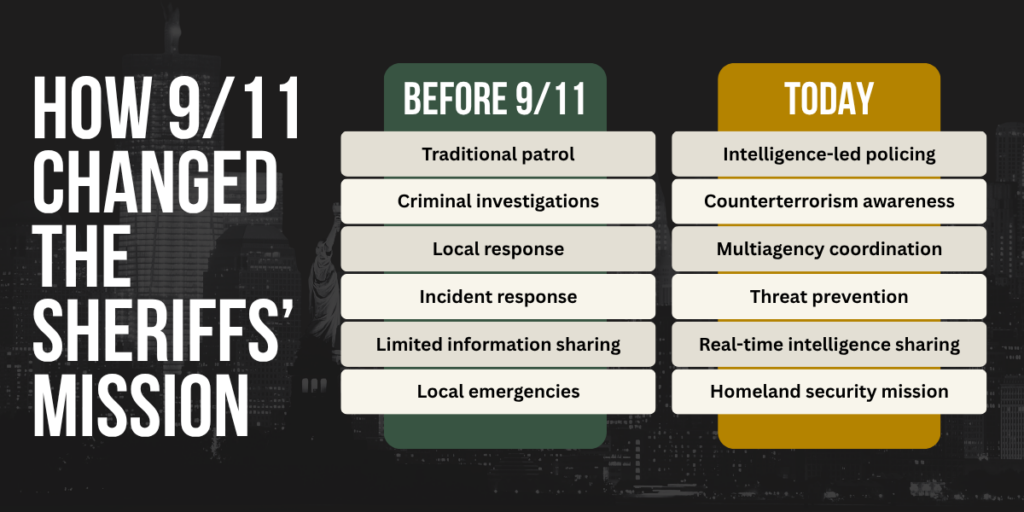
That structural shift required something deeper than new partnerships. It demanded a fundamentally different way of thinking about public safety. What began as a mission centered on patrol, criminal investigations, and local emergency response expanded to include counterterrorism awareness, multiagency coordination, and homeland security preparedness — requiring new training, new relationships, and a new operational mindset at every level of a sheriff’s office.
That evolution has never stopped. Florida’s domestic security structure is built on the recognition that the threat landscape is dynamic, that no single agency has a complete picture, and that the most effective defense is one that is deeply rooted in the communities it serves. Florida’s sheriffs understood that on September 12, 2001. They have acted on it every day since.
The Legacy: 25 Years Later
A quarter century after the 9/11 attacks, the lessons learned in their aftermath remain embedded in how Florida’s sheriffs operate every day. Intelligence-led policing, once a specialized capability, is now a baseline expectation. Deputies are trained to recognize the kind of behavioral indicators that, in hindsight, marked the hijackers’ time in Florida: irregular travel patterns, cash transactions, and flight training requests that raised no flags at the time but would trigger immediate scrutiny today. That shift in awareness did not happen once and settle. It has continued to evolve alongside new and emerging threats, from cyberattacks to domestic extremism, ensuring the mission never grows static.
Collaboration has proven just as durable a legacy. The multiagency coordination born out of the 2001 investigation, linking sheriffs’ offices with the FBI, state fusion centers, and federal homeland security partners, remains a permanent fixture of Florida law enforcement rather than a temporary response to a single event. Information that once moved slowly between agencies now flows in real time, giving sheriffs the ability to act on threats before they materialize rather than respond after the fact.
Never Forgetting
This anniversary carries particular significance in Florida, where several of the attackers trained, early federal investigations took shape, and the nation’s first state-level counterterrorism strategy was developed.
The Florida sheriffs who stepped into leadership roles in the weeks and months after September 11 did not do so because they were asked to fill a bureaucratic function. They did so because public safety — in every dimension, against every threat — is the core obligation of every sheriff’s office. That commitment is written into the structure of Florida’s domestic security system, and it is renewed every time a sheriff’s deputy takes a seat at an RDSTF meeting, contributes to a JTTF investigation, or works with federal partners to detect a threat before it becomes a tragedy.
Stand With Florida’s Sheriffs
Florida’s sheriffs have carried the lessons of September 11 forward for 25 years, and the partnerships among local, state, and federal agencies that made that transformation possible remain just as vital today. Become a member of the Florida Sheriffs Association and stand with the men and women who protect our communities every day. Membership directly supports the training, resources, and partnerships that keep Florida’s sheriffs prepared for the threats of tomorrow.
About the Florida Sheriffs Association
Founded in 1893, the Florida Sheriffs Association was established to unite Florida’s sheriffs in advancing public safety, shaping legislation, and fostering collaboration among law enforcement agencies. Over the decades, FSA has grown into a powerful advocate for law enforcement, providing training, resources, and support to ensure the protection and security of Florida’s communities.
The Florida Sheriffs Association will help you to stay informed on the latest law enforcement initiatives, public safety updates, and the work of Florida’s sheriffs. From in-depth blogs to legislative news and community programs, we keep you connected to the issues that matter. Explore more at flsheriffs.org and stay engaged with Florida’s law enforcement community.