

Human Trafficking Prevention in Florida

Human trafficking continues to affect individuals across Florida, often in ways that are not immediately visible. Addressing it calls for a thoughtful, coordinated effort among law enforcement, service providers, and community partners to recognize exploitation, respond with care, and support individuals impacted by trafficking. Florida law enforcement agencies contribute to these efforts through specialized training, collaborative work, and partnerships at the local, state, and federal levels, helping connect people to resources that promote safety, recovery, and prevention.
What Is Human Trafficking?
The National Human Trafficking Hotline defines human trafficking as a form of modern-day slavery, which exploits people for profit through force, fraud, or coercion. It can affect both adults and children and often occurs in everyday settings, sometimes involving individuals the victim knows or trusts. Human trafficking generally falls into two main categories: labor trafficking and sex trafficking.
Labor trafficking occurs when people are forced, deceived, or pressured into working or providing services against their will, often in industries such as agriculture, construction, hospitality, and domestic work. Sex trafficking involves compelling individuals to engage in sexual activity for money or something of value through force, fraud, or coercion, or involving a minor in paid sexual activity under any circumstances.
Both forms of trafficking frequently happen in plain sight — in locations people encounter every day, including hotels, restaurants, farms, massage businesses, and private homes. Victims are often controlled by a family member, romantic partner, employer, or another trusted individual, and may continue attending school or going to work while the exploitation remains hidden.
Why Human Trafficking Risk Is Higher in Florida
The University of South Florida’s Trafficking in Persons (TIP) Lab estimates that more than 700,000 Floridians were trafficked in 2024. Of those, 500,000 victims are estimated to have been subject to labor trafficking, and 200,000 to sex trafficking.
Florida’s economy and geography create a distinct set of conditions that increase vulnerability to human trafficking. The state’s role as a global travel and tourism hub, combined with its reliance on temporary labor, creates opportunities for exploitation that are less common in many other states.
Several factors can increase vulnerability to human trafficking in Florida. These include large tourism, agriculture, construction, and entertainment industries that rely on seasonal or transient workers; international airports and seaports that connect the state to global markets and migration routes; and major sporting events and entertainment venues that draw visitors from across the United States and around the world.
Human Trafficking Prevention in Florida
Law enforcement in Florida plays a critical role in preventing and combating human trafficking through a combination of proactive patrols, undercover operations, specialized training, and victim-centered programs.
In addition to your local sheriff, officers from agencies such as the Florida Department of Law Enforcement and the Florida Highway Patrol are trained to recognize indicators of trafficking and conduct investigations that can disrupt trafficking networks before victims are further harmed. These efforts often involve multi-agency task forces with local law enforcement and federal partners.
In Florida, all certified law enforcement officers, including sheriffs’ deputies, are required by law to complete at least four hours of human trafficking training within their first year of employment. This training is part of the state’s ongoing criminal justice education standards and is designed to help officers recognize the signs of both labor and sex trafficking, understand the methods traffickers use, and respond safely and effectively when encountering potential victims. By ensuring all officers receive this training, Florida strengthens its capacity to identify trafficking cases early, protect survivors, and bring perpetrators to justice.
Here are a few examples of how local law enforcement agencies in Florida work alongside community partners to address human trafficking and support individuals who may be affected.
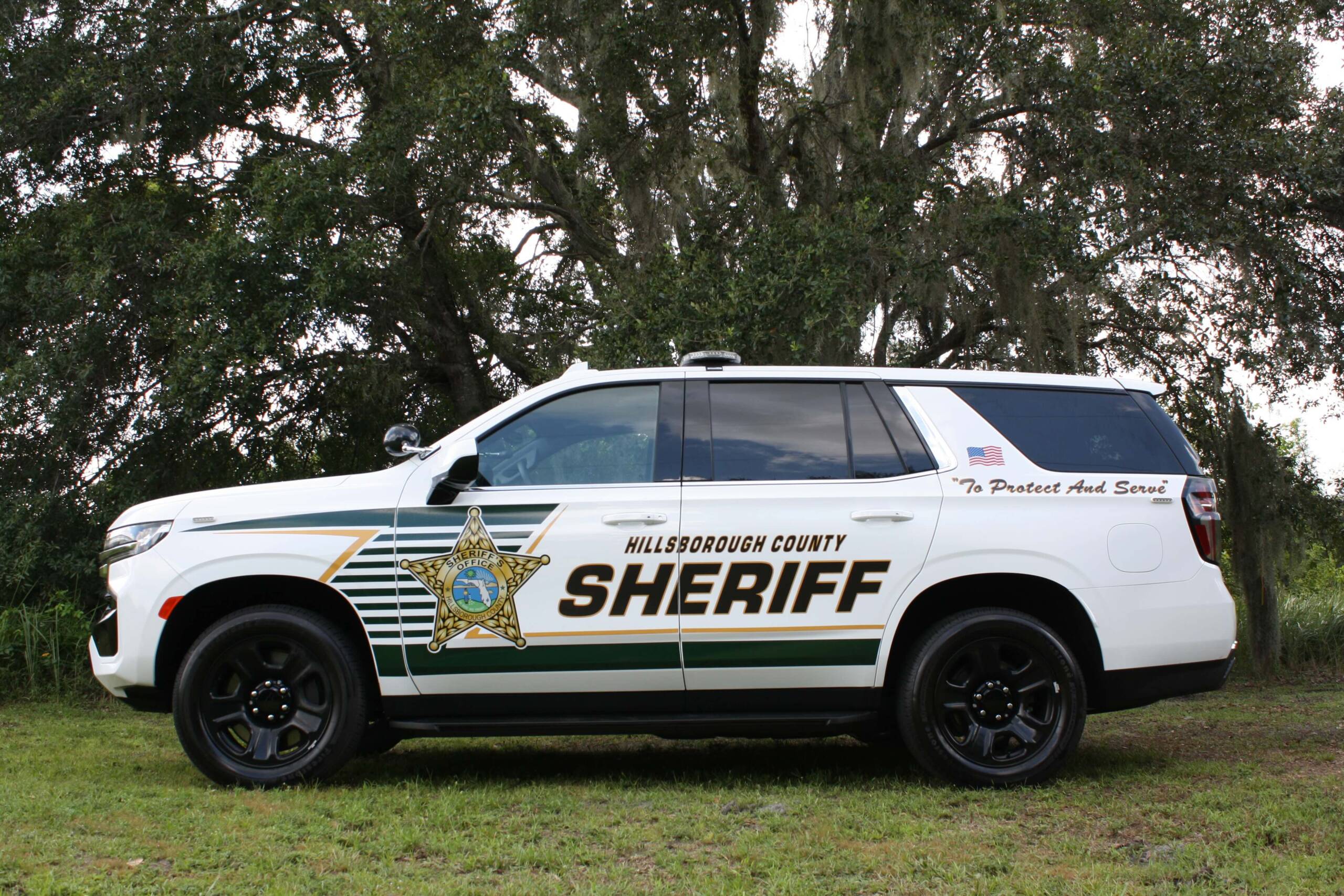
Hillsborough County Sheriff’s Office
The Hillsborough County Sheriff’s Office maintains a dedicated human trafficking section focused on identifying victims, disrupting trafficking networks, and holding offenders accountable.
- Conducts undercover and proactive operations, including online investigations targeting individuals seeking to exploit minors, such as Operation Unmasking Predators, which resulted in over 170 arrests and the rescue of multiple victims
- Participates in county, regional, and statewide task forces addressing human trafficking
- Works with nonprofit partners to ensure victims are connected to shelter, advocacy, and long-term services
Polk County Sheriff’s Office
The Polk County Sheriff’s Office has prioritized proactive enforcement, victim identification, and public accountability through high-profile operations and multi-agency collaboration. Key elements of Polk County’s approach include:
- Large-scale undercover sting operations targeting traffickers, buyers, and facilitators including Operation March Sadness 2024, an eight-day, multi-agency undercover human trafficking investigation that resulted in 228 arrests and the identification of 13 victims
- Close coordination with state and federal partners, including FDLE and homeland security agencies
- Strong emphasis on victim-centered responses and referral to support services
- Public education and transparency to raise awareness and deter trafficking activity
Palm Beach County Sheriff’s Office
The Palm Beach County Sheriff’s Office is a partner in the Palm Beach County Human Trafficking Task Force, which emphasizes a collaborative and victim-centered approach.
- Works alongside local, state, and federal law enforcement agencies, prosecutors, and service providers
- Utilizes federal grant funding to support investigations, prevention, and survivor services
- Prioritizes trauma-informed investigations that focus on victim safety and recovery
- Partners with organizations to provide housing assistance, case management, and legal, medical, and employment support
- Provides training and public education resources to help the community recognize trafficking indicators
Broward County Sheriff’s Office
The Broward County Sheriff’s Office combines investigative participation with strong community education and awareness efforts to combat human trafficking.
- Participates in multi-county and statewide task force operations, including initiatives coordinated by the Florida Sheriffs Association
- Engages the Strategic Investigations Division in enforcement and intelligence-driven efforts
- Implements public awareness tools, including QR codes and educational materials placed in high-traffic areas
Orange County Sheriff’s Office
The Orange County Sheriff’s Office contributes to anti-trafficking efforts through regional task force collaboration and community engagement across Central Florida.
- Participates in regional human trafficking task forces serving Orange, Osceola, and Seminole counties
- Works with partner agencies to identify victims, support investigations, reduce demand and disrupt trafficking activity
- Supports public awareness campaigns and community education initiatives
- Emphasizes a victim-centered, collaborative model that integrates enforcement with advocacy and prevention
Statewide Partnerships to Fight Trafficking
Combating human trafficking in Florida requires coordinated efforts among state and local agencies, advocacy groups, and specialized task forces. Together, these partnerships support prevention, investigations, and victim services, ensuring that survivors get the help they need and traffickers are brought to justice.
The Florida Human Trafficking Victims’ Fund
In 2023, advocates Sara Mahoney and Toni Azinger met with former Attorney General Ashley Moody to explore ways to make a real impact on human trafficking in Florida. Recognizing the urgent need for more resources to help law enforcement identify, rescue, and stabilize victims, this conversation sparked the creation of the Florida Human Trafficking Victims’ Fund — one of the nation’s first statewide public-private partnerships dedicated to combating trafficking.
Officially launched in March 2024, the fund quickly began providing support where it was most needed. Within nine months, six financial awards were granted to sheriff’s offices across the state, helping stabilize victims after rescue operations. Five counties reported operations resulting in the recovery and support of 73 victims, providing essential services such as trauma support, medical care, food, housing, and transportation. In 2025, the fund aided more than 100 survivors and supported over 20 law enforcement operations.
The fund is administered through the Florida Sheriffs Association with award distributions determined by the Florida Human Trafficking Committee.
Florida Human Trafficking Committee
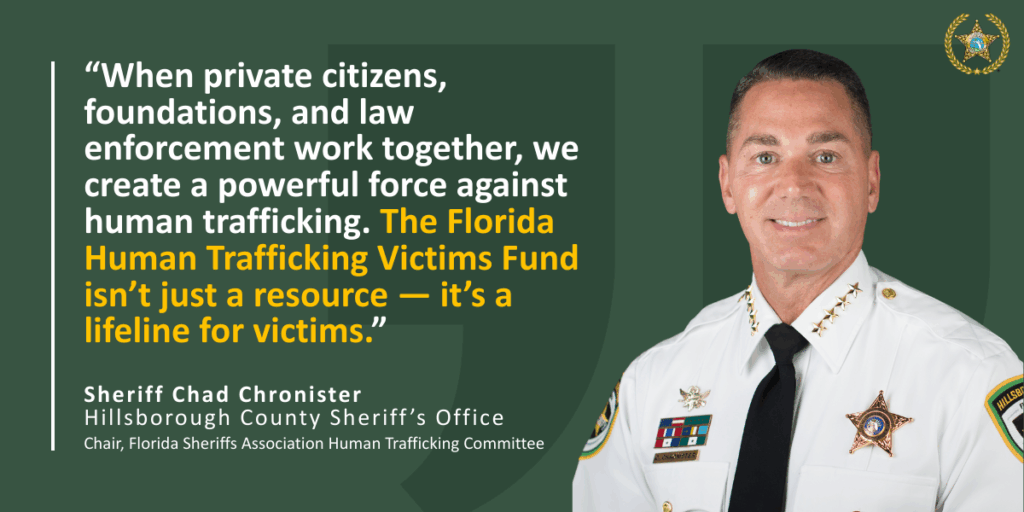
The Florida Human Trafficking Committee provides funding for the recovery and stabilization of victims while exemplifying leadership in crime-fighting and public protection. Through the Florida Sheriffs Association, the committee — led by Hillsborough County Sheriff Chad Chronister, along with Clay County Sheriff Michelle Cook and Monroe County Sheriff Rick Ramsay — ensures that Florida’s sheriffs have the tools and resources needed to respond quickly and effectively to human trafficking cases. Key strategies include allowing sheriffs to request emergency funds of up to $10,000 per event to stabilize victims after rescues and coordinating resources and support across the state’s 67 sheriff’s offices.
Help Stop Human Trafficking in Florida
Recognizing the signs of human trafficking is the first step in protecting victims and helping authorities take action. Being aware of both physical and verbal indicators can make the difference between a life continuing in danger and a life being rescued.
Know the Physical Signs: If you suspect someone may be a victim, look for signs such as malnourishment, disorientation, confusion, or sleep deprivation. Other warning signs may include branding (scars, burns, or tattoos), dental issues, infections, or apparent drug addictions.
Know the Verbal Signs: Pay attention to how the individual communicates. Fearfulness, anxiety, paranoia, or reluctance to discuss injuries can be red flags. It is also concerning if someone seems coached in what to say or allows another person to speak for them.
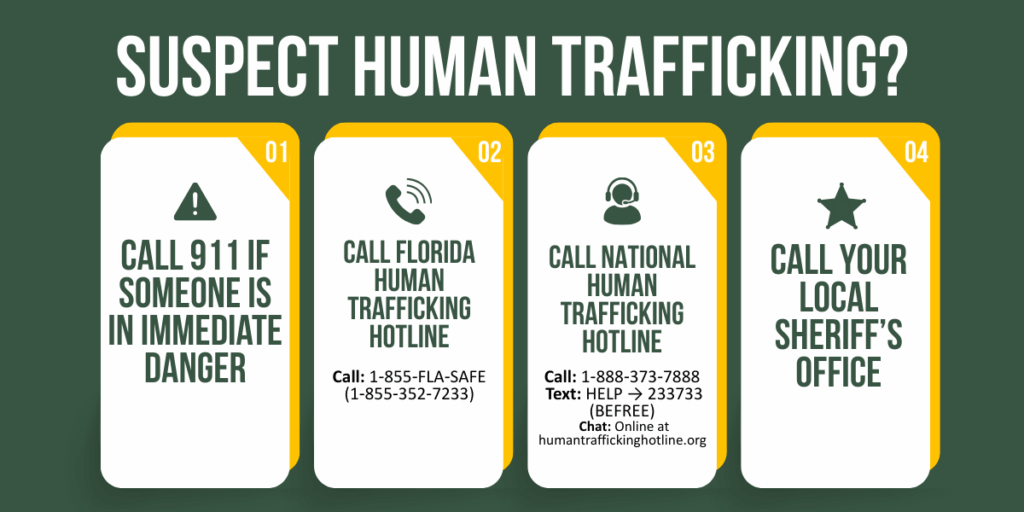
Take Action: Observing these signs is only the first step — prompt reporting is essential. Human trafficking can happen to anyone, anywhere, and it often goes unnoticed. If someone is in immediate danger, call 911. Otherwise, contact your local sheriff for assistance, or reach out to the following hotlines:
Florida Human Trafficking Hotline: 1‑855‑FLA‑SAFE (1‑855‑352‑7233)
National Human Trafficking Hotline: 1‑888‑373‑7888
- Text: HELP → 233733 (BEFREE)
- Chat: Online at humantraffickinghotline.org
Support Efforts: You can support survivors by donating to the Florida Human Trafficking Victims’ Fund, which provides critical resources and services to help victims rebuild their lives. This includes safe housing, medical and mental health care, legal assistance, education, and job training. Contributions ensure survivors have the tools and support they need to recover, regain independence, and thrive.
Get Involved: Human trafficking task forces operate in all 67 Florida counties. Find your local coalition and learn how your community is fighting this crime.
About the Florida Sheriffs Association
Founded in 1893, the Florida Sheriffs Association was established to unite Florida’s sheriffs in advancing public safety, shaping legislation, and fostering collaboration among law enforcement agencies. Over the decades, FSA has grown into a powerful advocate for law enforcement; providing training, resources, and support to ensure the protection and security of Florida’s communities.
The Florida Sheriffs Association leads statewide efforts to combat human trafficking by providing guidance, training, and resources to all 67 sheriff’s offices. Through initiatives like the Florida Human Trafficking Committee, we help coordinate investigations, support victim recovery, and distribute emergency funding to stabilize victims following rescues. Our work ensures law enforcement agencies are equipped to respond quickly and effectively to trafficking cases.
The Florida Sheriffs Association helps you stay informed on the latest law enforcement initiatives, public safety updates and the work of Florida’s sheriffs. From in-depth blogs to legislative news and community programs, we keep you connected to the issues that matter. Explore more at flsheriffs.org and stay engaged with Florida’s law enforcement community.