











The History of Florida’s Amendment 10

For many Floridians, Amendment 10 may have appeared to be another simple ballot item in 2018; but its impact will be felt for generations. By requiring every county to elect their constitutional officers, instead of appointing them, the amendment reshaped how local government works across the state, including in Miami-Dade, where the sheriff’s office had not been elected in decades. Understanding Amendment 10 means looking at why it was created, how it changed county governance, and why its impacts are still unfolding today.
History of the Sheriffs in Florida
The role of the sheriff in America has deep historical roots, with duties defined by colonial and state legislatures throughout the 18th and 19th centuries. Inheriting various responsibilities from their English counterparts, American sheriffs initially focused on law enforcement and tax collection. Over time, however, their responsibilities expanded to include the management of jails and workhouses, showcasing a significant evolution in their role.
As the only surviving office from these ancient positions, sheriffs have adapted to the changing demands of society, acting as conservators of peace in a modern context. In Florida, the Office of Sheriff has been recognized as a constitutional position since 1865. The term length for the office was originally set at two years but was changed to four years in 1868, reflecting the need for stability and continuity in law enforcement leadership. The appointment of county sheriffs transitioned from being in the hands of the governor to an elected role in 1899, and sheriffs were elected in all Florida counties for almost a century.
The History Behind Florida’s Amendment 10
But over the decades in some Florida counties, the Office of Sheriff was challenged, authority diminished and elected sheriffs were replaced with appointed leaders. That all changed when voters passed Amendment 10 in 2018, mandating that all counties in Florida elect all constitutional officers. The amendment marked a historic shift, requiring each Florida county to elect its sheriff, (along with property appraiser, tax collector, supervisor of elections, and clerk of court), emphasizing accountability and public engagement. The importance of Amendment 10 extends beyond procedural changes; it empowered citizens to directly elect their law enforcement leaders, ensuring those in positions of authority remain accountable to the public they serve.
Florida’s Amendment 10 has its roots in the state’s Constitution Revision Commission (CRC), a unique body that convenes only once every 20 years to review and propose updates to the state constitution. During the 2017–2018 cycle, the CRC considered a wide range of proposals from both its members and the public, ultimately approving a bundle of changes known as Proposal 6005 — what would become Amendment 10.
The amendment was designed to address multiple aspects of state and local government in one package. Among its goals were:
- Protecting the rights of voters to elect key county officials
- Safeguarding services for veterans
- Enhancing state security through a formal counterterrorism office
- Improving legislative predictability by standardizing the start of the state’s regular legislative sessions in even-numbered years
Amendment 10’s provisions regarding elected county officers were particularly significant. Before the amendment, some charter counties had the authority to abolish or restructure positions such as sheriff or tax collector. The amendment ensured that these offices remain elected in every county, strengthening voter control and limiting local government’s flexibility to make structural changes.
On November 6, 2018, Florida voters approved Amendment 10 with approximately 63% of the vote, embedding its provisions into the state constitution and making its changes more permanent than legislation. Its passage marked a significant moment in Florida’s ongoing effort to balance state oversight, local control, and citizen representation.
The Role of the Florida Sheriffs Association
The Florida Sheriffs Association (FSA) played a pivotal role in helping to advance Amendment 10, serving as a unifying voice for sheriffs across the state and a trusted advocate for voter accountability. Through sustained public education, strategic advocacy, and legal support, FSA championed the principle that sheriffs should remain directly accountable to the people they serve. By clearly articulating the importance of preserving the election of constitutional officers, FSA helped shape public understanding of the amendment and reinforced the democratic foundation of local law enforcement leadership in Florida. Most importantly, FSA worked to ensure that no county in Florida could ever abolish this important office ever again.
The History of Law Enforcement in Miami-Dade
Dade County was established in 1836 under the Territorial Act of the United States, with early law enforcement limited to just a handful of mounted deputies. Until 2024, Talmadge “T.A.” Buchanan was the last person elected to the role of sheriff in then-Dade County, serving from 1962 to 1966. Buchanan’s administration was clouded by corruption allegations, which ultimately forced his removal and led to the dissolution of the sheriff’s office by voter referendum — a decision that has shaped the county’s law enforcement framework for decades. Miami-Dade operated without an elected sheriff, relying on an appointed director because of the faith lost in the position.
Today, Miami-Dade County stands as Florida’s most populous county, featuring 34 incorporated municipalities, cities, towns, and villages, along with a diverse array of unincorporated communities and neighborhoods. The Miami-Dade Sheriff’s Office is the largest law enforcement agency in the Southeastern United States and ranks eighth in size across the nation, employing approximately 5,000 personnel, including 3,200 sworn officers.

Rosie Cordero-Stutz Makes History
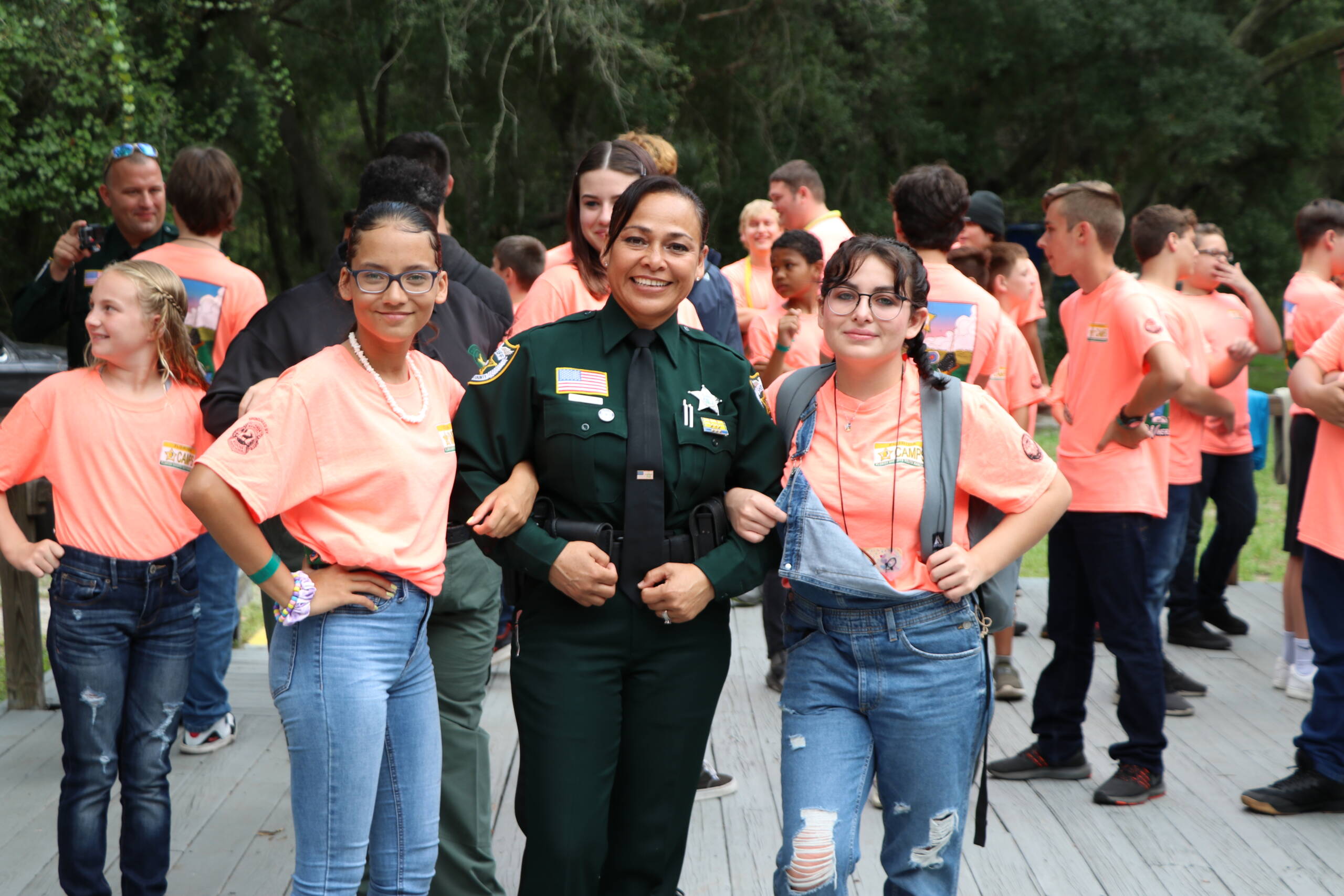
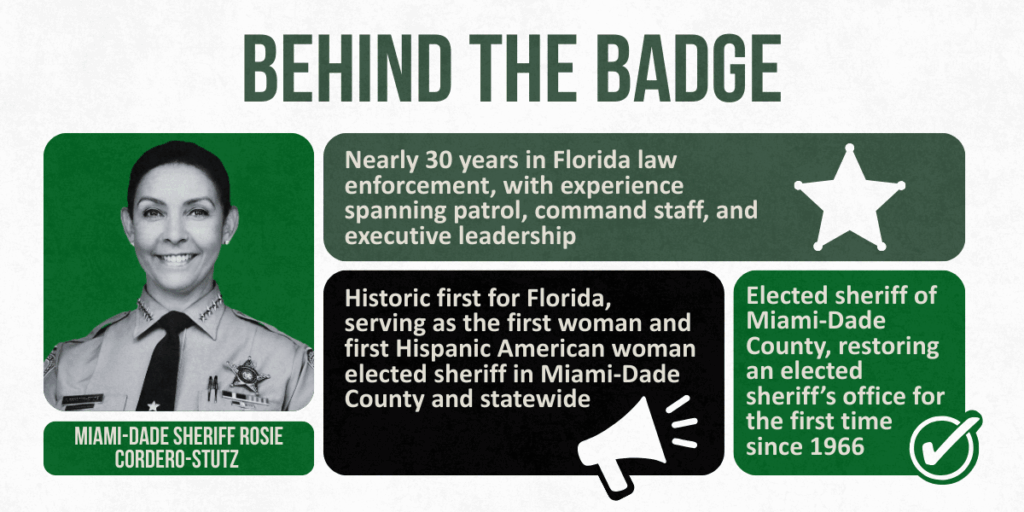
On November 5, 2024, Miami-Dade County marked a historic milestone by electing Rosie Cordero-Stutz as its first sheriff since 1966. Sheriff Cordero-Stutz’s victory is significant as it restores the role of an elected sheriff to Miami-Dade after nearly 60 years.
The Miami-Dade election for sheriff in 2024 not only fulfills the Amendment 10 mandate, but it also allows voters to select a candidate who is intimately familiar with local law enforcement needs and best practices.
Originally from New York City, Sheriff Cordero-Stutz has dedicated her entire 28-year career to law enforcement. Since joining MDPD in 1996, she has worked as a street officer and has progressed through a series of promotions to detective, major, and chief. Before her election, Sheriff Cordero Stutz was assistant director of investigative services.
In August, Sheriff Cordero-Stutz achieved a significant milestone by becoming the first Hispanic woman elected as president of the FBI National Academy Association, an organization committed to enhancing police practices through its network of senior law enforcement professionals. She is also responsible for heading the county’s Sheriff International Transition Team, ensuring a smooth transition of the MDPD from county governance.
Sheriff Cordero-Stutz made history by becoming Miami-Dade’s first female sheriff and the first Hispanic female sheriff in Florida. The restructuring means that while city police departments remain autonomous, the entire county police department will transition into a sheriff’s office under her management. With a robust background within the MDPD, Cordero-Stutz has outlined her commitment to a community-based perspective, emphasizing relationships with local organizations and a dedication to transparency.
Why Amendment 10 Matters Today
More than five years after its passage, Amendment 10 continues to influence how Floridians interact with their government at both the state and local levels. One of its most visible impacts is on county governance. By guaranteeing that key offices are elected, the amendment ensures that voters retain direct control over positions that affect public safety, property taxes, and election integrity. Counties can no longer eliminate or convert these constitutional offices to appointed positions, preserving accountability and consistency across the state.
Amendment 10 not only preserved voters’ rights and strengthened key institutions but also provided a framework for greater stability, transparency, and accountability in Florida government — impacts that continue to shape the state’s operations today.
About the Florida Sheriffs Association
Founded in 1893, the Florida Sheriffs Association was established to unite Florida’s sheriffs in advancing public safety, shaping legislation, and fostering collaboration among law enforcement agencies. Over the decades, FSA has grown into a powerful advocate for law enforcement; providing training, resources, and support to ensure the protection and security of Florida’s communities.
“FSAcast,” the official podcast of the Florida Sheriffs Association, shares conversations with Florida’s sheriffs, elected officials, and law-enforcement professionals from across the country discussing issues relevant to Florida residents, our visitors, and our more than 100,000 honorary members. For more in-depth information on Amendment 10, “FSAcast” features a four-part series, The Oral History of Amendment 10 and Protecting the Office of Sheriff:
- Part 1: The Bill that Died on the Floor
- Part 2: Florida’s 20-Year Quirk
- Part 3: Passage of the Protection Amendment
- Part 4: County Maneuvering, Lawsuits, State Legislation, and Finality
The Florida Sheriffs Association helps you stay informed on the latest law enforcement initiatives, public safety updates, and the work of Florida’s sheriffs. From in-depth blogs to legislative news and community programs, we keep you connected to the issues that matter. Explore more at flsheriffs.org and stay engaged with Florida’s law enforcement community.