























How Ted Bundy’s Crimes Impacted Law Enforcement

Ted Bundy’s crimes in the late 1970s left a lasting impact on law enforcement and the justice system. As one of the most notorious serial killers in U.S. history, Bundy’s case exposed serious gaps in areas ranging from jail security to interstate communication. His crimes prompted significant reforms that continue to influence criminal justice policies today including stronger jail protocols, advancements in forensic techniques such as bite mark analysis, improved collaboration between states and the creation of federal tools such as the Violent Criminal Apprehension Program (ViCAP). Perhaps most notably, Bundy’s crimes sparked a national push for victim advocacy and heightened awareness about the dangers of predatory violence, particularly against women.
To read more about Ted Bundy’s crimes please visit our previous blog Remembering Ted Bundy and the Chi Omega Murders.
Inmate Security Reform
Ted Bundy famously escaped custody twice. First from a Colorado courthouse in 1977 and later from a Colorado jail, ultimately resurfacing in Florida, where he committed more violent crimes.
Bundy’s ability to represent himself in court granted him access to the law library, from which he made his first escape by jumping out of a second-story window. This incident prompted courts to reconsider the extent of privileges afforded to pro se defendants (a person who represents themselves in a legal proceeding without the assistance of a lawyer), especially those accused of violent crimes.
Ted Bundy’s second escape from jail on December 30, 1977 remains one of the most infamous jailbreaks in American criminal history. At the time, Bundy was being held at the Garfield County Jail in Glenwood Springs, Colorado, awaiting trial for the murder of Caryn Campbell. Over the course of several weeks he intentionally lost about 30 pounds, allowing him to squeeze through a small hole in the ceiling of his jail cell. After creating a decoy using books and blankets to make it appear he was asleep, Bundy climbed into the crawl space above his cell, crawled through the ceiling, and dropped down into the jailer’s apartment. From there, he simply walked out the front door. His absence wasn’t discovered for nearly 15 hours.
By the time authorities realized he was gone, Bundy had already fled Colorado and was on his way to Florida. Within weeks he would commit some of his most brutal and high-profile crimes.
Bundy’s escape not only exposed serious lapses in jail security but also tragically enabled him to continue his killing spree.These high-profile escapes revealed alarming gaps in jail security, courtroom procedures and inmate oversight. Bundy’s escapes underscored how dangerous individuals could exploit even minor lapses in security—a lesson that reshaped courtroom and correctional policies nationwide. The resulting impact on inmate security was:
- Stricter security protocols for inmate transport, courtroom access and detention facilities, especially for high-risk offenders.
- Improved correctional facility designs and stricter inmate monitoring.
- Tighter control over inmates’ access to legal materials, evidence and private meetings with attorneys, particularly for those representing themselves.
- In some jurisdictions, Bundy’s manipulation of the legal system led to greater scrutiny of pro se (self-representation) rights, with courts imposing stricter competency evaluations and placing limits on self-representation in complex cases.
Bundy’s calculating nature and the devastation he caused after escaping custody forced the criminal justice system to confront dangerous gaps in its procedures.
Use of Forensic Evidence
Bundy’s trial was one of the first high-profile criminal cases in the U.S. to rely on bite mark analysis as key forensic evidence, particularly in connection to the Chi Omega sorority house murders at Florida State University.
How Were Bite Marks Used?
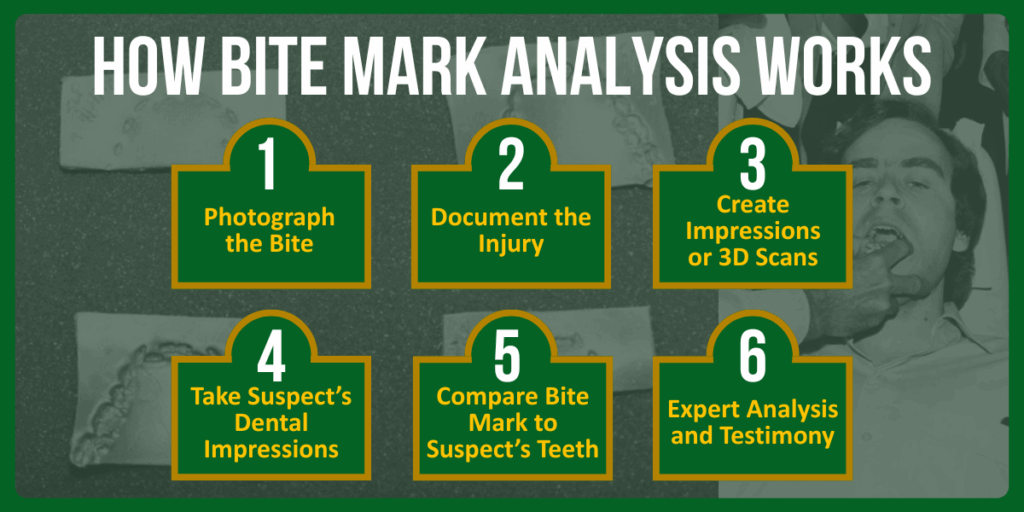
- Forensic experts documented bite marks found on victim Lisa Levy’s body using detailed photographs.
- After Bundy’s arrest, authorities took dental impressions of his teeth. His dental pattern was highly distinctive, featuring chipped teeth, misalignment and irregular spacing.
- Forensic odontologists compared the bite mark photographs to Bundy’s dental impressions and testified that the marks matched his teeth with a high degree of certainty.
- This bite mark evidence provided the most direct physical link connecting Bundy to the Chi Omega sorority crime scene.
At the time, Bundy had left behind no fingerprints, and DNA testing was not yet widely available. The bite mark analysis became a pivotal component of the prosecution’s case and helped secure his conviction. Bundy’s trial is still regarded as a landmark moment for forensic dentistry, increasing the acceptance of bite mark analysis as courtroom evidence. The case also contributed to the broader normalization of forensic science in criminal investigations and trials, paving the way for expanded use of disciplines such as forensic pathology, trace evidence analysis and eventually, DNA profiling. While bite mark analysis remains controversial today, its role in the Bundy trial marked a significant evolution in forensic techniques used in the justice system.
Interstate Law Enforcement Cooperation
Bundy committed murders across multiple states including Washington, Utah, Colorado and Florida which significantly complicated efforts to track, apprehend and connect his crimes. At the time, law enforcement agencies operated largely in isolation, with limited mechanisms for sharing information across state lines.
Bundy’s ability to evade capture by crossing jurisdictions exposed critical weaknesses in interstate communication and cooperation among police departments, prosecutors and investigative units. His case underscored the urgent need for better coordination between law enforcement agencies nationwide.
Ted Bundy’s crimes contributed to the development of the FBI’s Violent Criminal Apprehension Program (ViCAP), launched in 1985. ViCAP created a centralized system to track and analyze violent crimes, particularly homicides, sexual assaults and missing persons cases with suspected foul play.
The case also accelerated investment in integrated criminal databases, laying the foundation for systems such as the NCIC (National Crime Information Center) for real-time nationwide records on fugitives, stolen property, and missing persons; CODIS (Combined DNA Index System) for sharing DNA profiles across jurisdictions to help solve violent crimes and other national registries for tracking sex offenders, fugitives and violent offenders.
Today, centralized databases and interstate collaboration are standard practice, but Bundy’s case highlighted just how fragmented the system once was and how dangerous those gaps could be in the pursuit of serial offenders.

Victims’ Rights Movement
Ted Bundy’s crimes helped spark the victims’ rights movement in the U.S. His victims were predominantly young women, many of them college students, which exposed how easily predators could exploit gaps in public safety and community awareness.
In the aftermath of his crimes, grassroots movements and survivor advocacy organizations gained momentum, pushing for better support systems for victims and greater accountability within law enforcement. Public demand grew for more proactive measures to prevent gender-based violence, leading to the rise of campus safety programs, self-defense education and victim assistance initiatives.
Bundy’s case also underscored the need for more respectful and compassionate treatment of victims and their families within the justice system. These efforts laid the foundation for significant policy changes including:
- The development of Victim Impact Statements, allowing victims or their families to speak during sentencing hearings.
- The passage of state and federal victims’ rights legislation, such as the Victims of Crime Act of 1984, which provided federal funding for victim services.
- The expansion of advocacy groups offering emotional support, legal guidance and protection for victims’ families.
Together, these efforts marked the beginning of a broader victims’ rights movement that continued to grow throughout the 1980s and 1990s.
Advancing Public Safety Through Legislative Action
Ted Bundy’s case did not create new laws or change overnight, but it exposed flaws and vulnerabilities in nearly every aspect of the justice system—from law enforcement coordination and security protocols to forensic reliability and victim support. This case sparked a national conversation that would eventually lead to meaningful legal reform. Recognizing the need for lasting solutions to these systemic challenges, organizations like the Florida Sheriffs Association (FSA) play a vital role in transforming lessons from past shortcomings into proactive legislative action.
One of the Florida Sheriffs Association’s primary roles and responsibilities is to support and monitor legislation that ensures public safety in Florida. Both during the legislative session and throughout the year, FSA’s legislative team is actively working with lawmakers to ensure that bills are introduced and passed that are in the best interests of Florida citizens and protect the ability of Florida law enforcement to keep communities safe. Learn more about FSA’s legislative efforts and priorities on our website.
About the Florida Sheriffs Association
Founded in 1893, the Florida Sheriffs Association was established to unite Florida’s sheriffs in advancing public safety, shaping legislation and fostering collaboration among law enforcement agencies. Over the decades, FSA has grown into a powerful advocate for law enforcement, providing training, resources and support to ensure the protection and security of Florida’s communities.
The Florida Sheriffs Association helps you stay informed on the latest law enforcement initiatives, public safety updates and the work of Florida’s sheriffs. From in-depth blogs to legislative news and community programs, we keep you connected to the issues that matter. Explore more at flsheriffs.org and stay engaged with Florida’s law enforcement community.