










Impaired Driving Prevention: What Every Florida Driver Should Know

Each December, the nation observes National Impaired Driving Prevention Month. The observance coincides with the holiday season, when parties, family gatherings, and long trips to see relatives put more people on the road, and alcohol is often part of the celebration.
The cost of impaired driving is measured in lives. In 2024, 11,904 people died in alcohol-impaired driving crashes in the U.S., about one death every 44 minutes, according to the National Highway Traffic Safety Administration (NHTSA). In Florida, impaired driving crashes killed 969 people in 2023, nearly 29% of all traffic deaths in the state, according to crash data from the Florida Department of Highway Safety and Motor Vehicles (FLHSMV).
Every one of those crashes traces back to a decision someone could have made differently. Continue reading to learn how to avoid driving impaired, recognize an impaired driver on the road, report one in Florida, and speak up when someone you know should not get behind the wheel.
Plan Your Ride Home
Alcohol affects judgment before most people feel drunk, which makes the end of the night the worst time to decide how to get home. Make your transportation plans before you leave the house. Choose a designated driver who commits to staying sober for the entire event. If no one in your group can drive, schedule a rideshare or taxi, use public transportation, or arrange to stay the night.
Feeling “fine” is not a reliable test. NHTSA reports that 2,028 people died in 2024 in crashes involving a driver with a blood alcohol concentration (BAC) between 0.01 and 0.07, below the legal limit. If you have had anything to drink, hand off the keys.
Coffee, fresh air, a cold shower, or a little extra time will not reliably restore your ability to drive safely after drinking. The safest choice is to arrange a sober ride rather than try to judge whether you are ready to drive. If you are the designated driver, commit to staying sober throughout the event.
Medications, Marijuana, and Other Drugs
Florida law treats impairment from drugs the same way it treats impairment from alcohol. Under Section 316.193, Florida Statutes, a driver commits driving under the influence (DUI) when alcohol, certain chemical substances, or any controlled substance impairs their normal faculties, or when their blood or breath alcohol level is 0.08 or higher. FLHSMV notes that drug-impaired driving carries the same penalties as alcohol-impaired driving.
Marijuana deserves particular attention. Unlike alcohol, marijuana has no specific impairment limit, and it affects each person differently. It can slow reaction time, reduce coordination, and make it harder to judge time and distance — all skills drivers need to avoid an accident.
Some prescription and over-the-counter medications, including certain sleep aids, allergy medicines, and pain relievers, cause drowsiness or slow reaction time. Read the warning label before you drive. When a label is unclear, ask your doctor or pharmacist about side effects, and never combine medication with alcohol before driving.
Using more than one substance can increase impairment and make driving even more dangerous. Alcohol can also interact with prescription and over-the-counter medications, increasing drowsiness or slowing reaction time. If you are unsure how a medication or substance may affect you, do not drive until you have confirmed it is safe to do so with a qualified health care professional.
Host Holiday Gatherings Responsibly
As a host, you can help guests enjoy the celebration while making sure everyone gets home safely. A few simple steps can make a big difference:
- Offer appealing nonalcoholic drink options.
- Stop serving alcohol about an hour before the party ends.
- Ask guests about their plans for getting home when they arrive.
- Keep rideshare and taxi information handy.
- Offer a couch or guest room to anyone who needs a place to stay.
- If a guest has had too much to drink, offer to help arrange a safe ride home and keep their keys until they’re able to drive safely.
Before You Go
A little planning before you head out can help keep you and others safe. Make responsible decisions before you go, plan for a safe ride home, and take a few simple steps to look out for yourself and others.
- Decide who is driving, or how you are getting home, before you leave.
- Read the warning label on any medication you have taken that day.
- Save a rideshare app, a taxi number, and a sober friend’s number in your phone.
- If you are hosting, stock food and nonalcoholic drinks, and help guests plan their rides.
- If you have a teen driver, establish a safe pickup plan they can count on if a night takes an unexpected turn.
Warning Signs of an Impaired Driver
Law enforcement officers are trained to identify impaired drivers using driving cues documented by NHTSA in its law enforcement guide, The Visual Detection of DWI Motorists. Other drivers can watch for many of these same signs, which may indicate impairment, distraction, or drowsiness. One sign alone may point to a distracted or drowsy driver, but several together are reason to keep your distance and call for help.
- Weaving, drifting, or straddling the lane line
- Turning wide or nearly striking a vehicle, curb, or other object
- Braking erratically or stopping in a lane for no apparent reason
- Driving 10 mph or more under the speed limit, or speeding up and slowing down without cause
- Driving at night without headlights
- Responding slowly to traffic signals
- Driving in opposing lanes or the wrong way on a one-way street
How to Report an Impaired Driver in Florida
If you see a driver you believe is impaired, protect yourself first. Stay well back from the vehicle, and do not follow it, pass it, or try to signal or stop the driver. Have a passenger make the call or pull over to a safe location before you dial.
To report an impaired driver, call 911 or dial *FHP (*347) from your cellphone. The *FHP line connects callers free of charge to the nearest Florida Highway Patrol communications center through participating Florida cellular providers. For any immediate danger, call 911.
Sharing key details can help deputies and troopers locate the vehicle quickly and prevent a crash. If you can do so safely, provide your location, the vehicle’s direction of travel, its make, model, color, and tag number, if visible, and the driving behavior you observed, such as weaving, running a red light, or driving without headlights. Even partial information can help.
Never put yourself or others at risk to gather information about a suspected impaired driver. Do not speed, follow the vehicle closely, or use your phone while driving to capture its tag number. Share what you can safely observe and let law enforcement handle the situation.
Advocate for Yourself: Speak Up as a Passenger, Friend, or Parent
As a Passenger: You have the right to refuse a ride. If the driver has been drinking or using drugs, do not get in the car. If you are already in the vehicle, ask to be let out at a safe, well-lit location and call someone you trust. But children don’t always have the ability to recognize the danger or remove themselves from an unsafe situation, making their safety even more dependent on the choices adults make. NHTSA reports that in 2024, 21% of children 14 and younger killed in traffic crashes died in drunk-driving crashes, and more than half of those children were riding in the impaired driver’s vehicle.
As a Friend or Family Member: Talk to the person privately and calmly. Keep the focus on getting them home safely, offer to drive or call a ride, and take the keys if you can do so without putting yourself at risk. If the person refuses help, avoid escalating the situation or putting yourself in danger. Ask another trusted person to help encourage a safer choice, and offer alternatives such as a rideshare, taxi, or place to stay. If the person drives away and you believe they are impaired, call 911 when it is safe to do so and share the vehicle’s description and direction of travel.
As a Parent: Talk with your teen before holiday break begins. Agree on a code word or text that means “come get me,” and promise a ride with no lecture that night. Then model the behavior you expect. NHTSA data shows 29% of drivers ages 15 to 20 killed in crashes in 2024 had alcohol in their system.
Frequently Asked Questions
Can I call 911 while driving to report an impaired driver?
Florida law allows drivers to use a wireless device to report an emergency or criminal or suspicious activity to law enforcement. However, in school zones and active work zones, drivers are required to use a hands-free device. The safest choice is to have a passenger make the call or pull over in a safe location before calling 911.
Can I report an impaired driver anonymously?
You may be asked for your name and phone number so officers can follow up. If you have concerns about sharing your information, discuss that when you call.
Will I have to go to court?
Your call gives law enforcement a reason to locate the vehicle. Officers then build the case on what they observe after they find the driver. In some cases, investigators may contact a caller for a statement.
What if the impaired driver is a family member?
Treat the situation the same way you would with anyone else. Offer a ride, take the keys if you can do so safely, and call 911 if they drive. A difficult conversation is worth having when the alternative is an accident.
Does a prescription or medical marijuana card protect me from a DUI?
No. Florida’s DUI law applies when any controlled substance impairs your normal faculties, and it does not make an exception for a substance you are legally allowed to use. A valid prescription or medical marijuana card does not make it legal to drive impaired.
Every Impaired Driving Crash Is Preventable
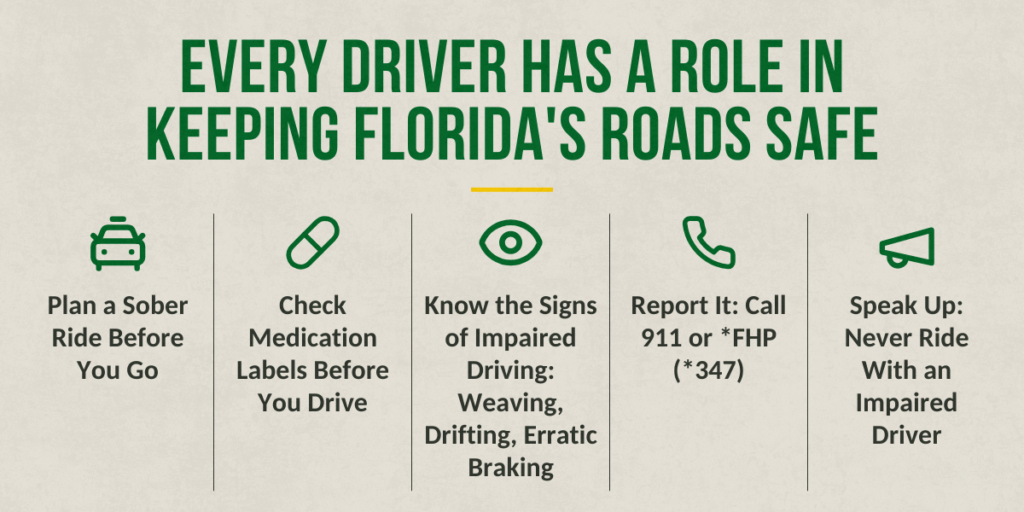
Each impaired driving crash follows a choice to drive after drinking or using drugs, or a missed chance for someone else to step in. Planning a sober ride, checking medication labels, knowing the warning signs, and reporting a suspected impaired driver are simple steps that save lives on Florida’s roads, in December and every month of the year.
The Florida Sheriffs Association (FSA) represents Florida’s 67 sheriffs, whose offices enforce the state’s DUI laws and respond to impaired driving crashes in communities across Florida. Sheriff’s offices also work to prevent those crashes through traffic enforcement and community education.
Take the Next Step
- Make a plan: Line up a designated driver, rideshare, or taxi before any celebration involving alcohol or other substances.
- Report it: If you see a suspected impaired driver, pull over safely or have a passenger call 911 or *FHP (*347).
- Speak up: Don’t ride with an impaired driver and help friends and family find another way home.
- Stay informed: Visit FSA’s website for additional public safety resources and information.
About the Florida Sheriffs Association
Founded in 1893, the Florida Sheriffs Association was established to unite Florida’s sheriffs in advancing public safety, shaping legislation, and fostering collaboration among law enforcement agencies. Over the decades, FSA has grown into a powerful advocate for law enforcement, providing training, resources, and support to ensure the protection and security of Florida’s communities.
The Florida Sheriffs Association will help you to stay informed on the latest law enforcement initiatives, public safety updates, and the work of Florida’s sheriffs. From in-depth blogs to legislative news and community programs, we keep you connected to the issues that matter. Explore more at flsheriffs.org and stay engaged with Florida’s law enforcement community.