







Law Enforcement Bomb Squad Units Spotlight

Every day, law enforcement responds to calls that range from routine to unpredictable. But some calls require a level of specialized training and equipment that goes far beyond standard patrol response. Bomb squad units in law enforcement exist precisely for those moments, providing the expertise, tools, and calm under pressure needed to safely identify and neutralize explosive threats so that deputies, first responders, and the public can stay safe.
While many people still use the term “bomb squad,” these specialized teams are increasingly referred to as Explosive Ordnance Disposal (EOD) units. The shift reflects the broad range of responsibilities these highly trained specialists undertake, including identifying, rendering safe, and disposing of explosive hazards such as improvised explosive devices (IEDs), military ordnance, and other dangerous materials.
Bomb Squad Unit Mission and Purpose
The primary purpose of a bomb squad unit is to protect lives and public safety by detecting, assessing, and neutralizing explosive threats that are beyond the capability of standard law enforcement response. Bomb squads exist because explosive devices represent a unique and highly specialized category of threat — one that requires dedicated training, equipment, and expertise to address safely and effectively.
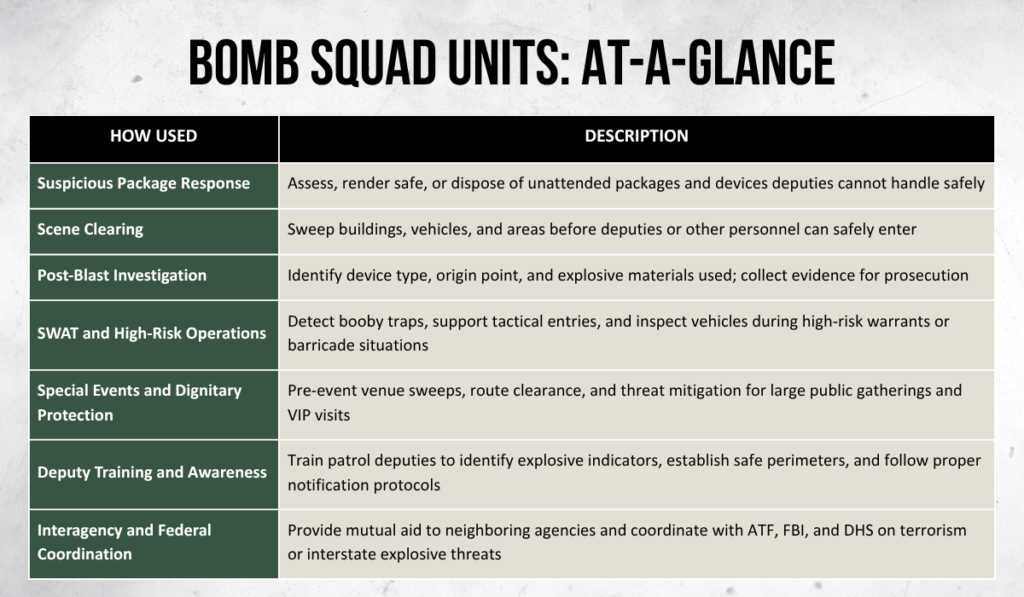
At its core, the mission of a bomb squad unit can be summed up simply: to stand between the community and one of the most dangerous threats in law enforcement so that deputies, first responders, and the public never have to face it alone. The mission of a bomb squad unit encompasses several key areas:
Threat Neutralization: To locate, identify, and render safe explosive devices whether real, suspected, or improvised, before they can cause harm to people, property, or critical infrastructure.
Public Safety: To protect the community from explosive threats by responding rapidly to incidents, clearing scenes, and ensuring that civilians and first responders can operate without risk of harm.
Support to Law Enforcement: To serve as a specialized resource for patrol deputies, investigators, and tactical teams by providing expertise and assistance on calls that involve explosive hazards, booby traps, or suspected bomb-making activity.
Criminal Investigation: To assist in the investigation and prosecution of crimes involving explosives by conducting post-blast investigations, collecting and preserving evidence, and providing expert testimony in criminal proceedings.
Prevention and Preparedness: To reduce the risk of explosive incidents through community awareness, deputy training, venue sweeps, and coordination with federal partners on threat intelligence and emergency preparedness.
Interagency Coordination: To work alongside federal agencies such as the Bureau of Alcohol, Tobacco, Firearms and Explosives (ATF), the Federal Bureau of Investigation (FBI), and the Department of Homeland Security on cases that cross jurisdictional lines or involve national security implications.
Equipment That Supports Bomb Squad Operations
Bomb squad units in law enforcement rely on an array of specialized equipment, including robots, bomb suits, disrupters, and portable X-ray systems to safely assess and neutralize explosive threats. Each tool serves a specific purpose and plays a critical role in the overall response.
Remotely Operated Robots: Robots like the QinetiQ TALON allow technicians to approach a device without placing a human at risk. They can carry cameras, X-ray equipment, and disruptors to assess and act on a threat from a safe distance.
Bomb Suits: When a technician must approach manually, the bomb suit provides critical protection. Modern suits include a helmet with an integrated communications system, allowing the technician to stay in contact with team members throughout a render-safe procedure.
X-Ray Systems: Portable X-ray units allow bomb techs to see inside a suspicious package or device without opening it, identifying wiring, components, and potential trigger mechanisms before taking action.
Water Disruptors and Firing Systems: A water disruptor fires a high-velocity jet of water to physically displace the components of a device, severing connections and disabling it without triggering detonation. Fired remotely, it is one of the most commonly used tools bomb technicians use to safely neutralize threats.
Bomb Containment Vessels: Portable containment vessels allow technicians to safely move a device to a controlled environment where it can be destroyed with minimal risk to the surrounding area.
Drones in Bomb Squad Operations
Unmanned aircraft systems are increasingly integrated into bomb squad operations, giving teams an aerial view of a scene before committing personnel and equipment. Law enforcement agencies across Florida are deploying drones for explosive-related missions with significant benefits.
- Rapid pre-arrival reconnaissance: Drones can overfly a scene before the bomb squad vehicle arrives, giving technicians a layout of the area and the location of the device.
- Perimeter monitoring: Drones help incident commanders monitor the security perimeter and watch for secondary devices placed to harm first responders.
- Hazardous area access: Their small size allows drones to safely operate around structures, vehicles, or confined spaces where ground-level access is limited.
- Real-time imagery: High-resolution cameras and thermal sensors provide live footage to support decision-making during active incidents.
- Officer safety: Sending a drone ahead of personnel into an unknown situation improves situational awareness and reduces exposure to risk.
How Bomb Squad Units Support Law Enforcement
Bomb squads play a critical support role in law enforcement by responding to explosive threats, suspicious packages, and hazardous devices that require specialized training and equipment. These units work alongside patrol officers, SWAT teams, fire departments, and federal agencies to help secure scenes, protect the public, and safely neutralize potential threats. In addition to emergency response, bomb squads often assist with major public events, criminal investigations, and training exercises focused on public safety and threat prevention.
K-9s and Bomb Squad Operations
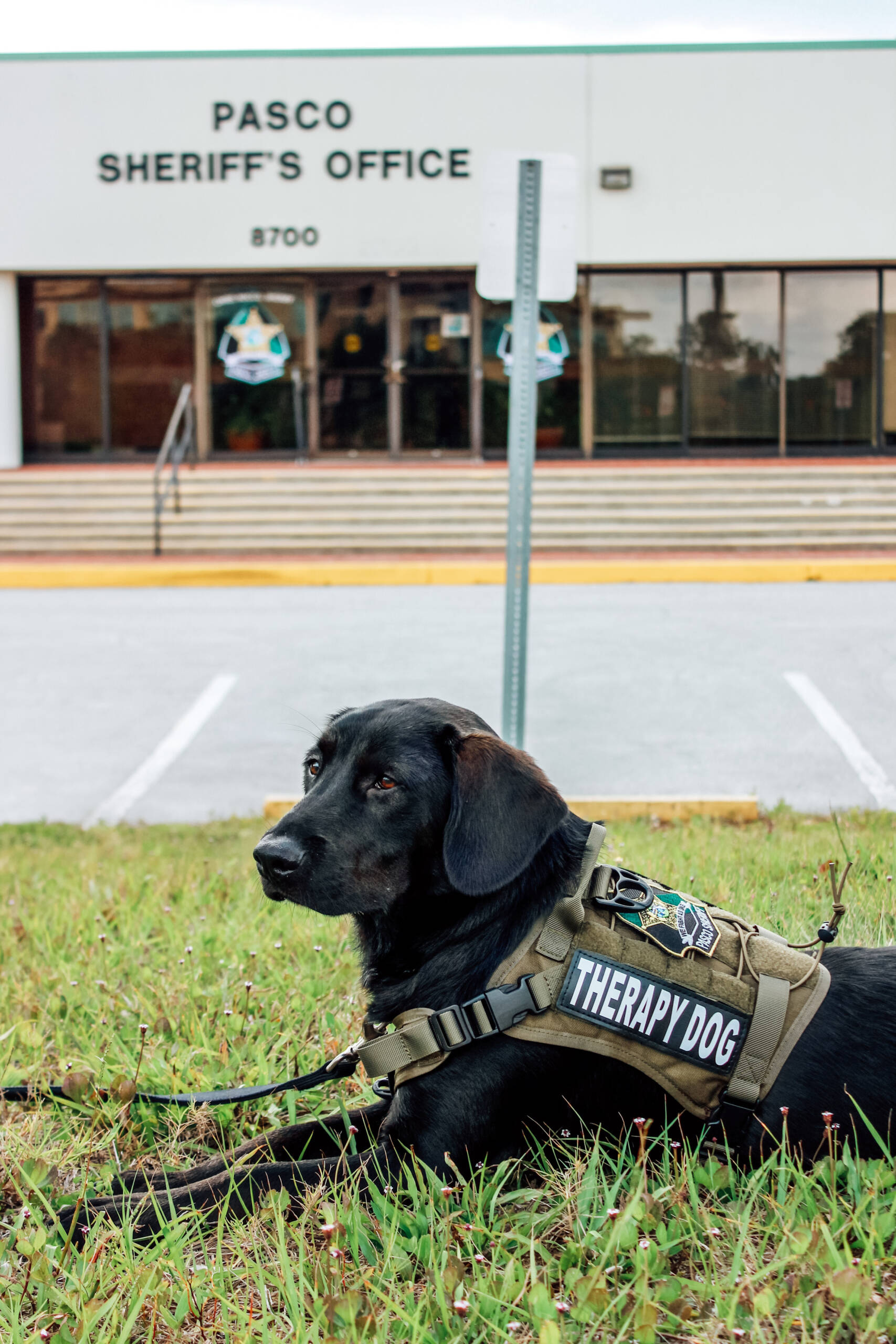
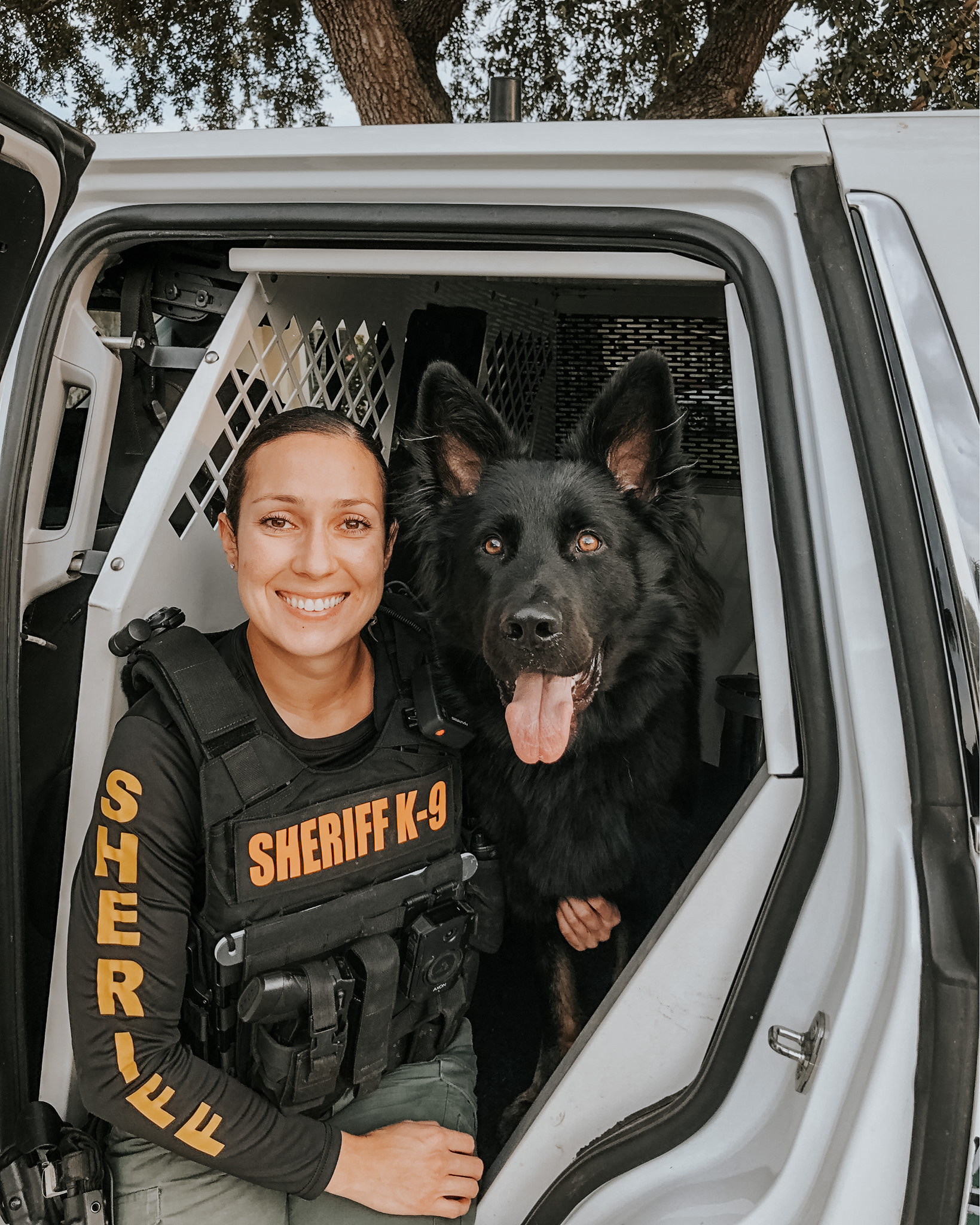
One of the most valuable specialized assets within bomb squad operations is the explosive detection K-9 team. These dogs are specially trained to detect the scent of explosive materials and alert their handler to its presence. Their ability to identify trace explosive odors across a wide range of compounds allows bomb squads to clear large areas more quickly and reduce risk to personnel. Explosive detection K-9s are considered one of the most reliable detection tools available to bomb squads, capable of recognizing dozens of different explosive compounds in operational environments.
A well-trained K-9 can detect dozens of explosive compounds that no technology has been able to fully replicate, and they are deployed across a wide range of operational settings:
- Sweeping stadiums, arenas, and public spaces before large crowds arrive
- Locating unexploded devices or residual materials at post-blast crime scenes
- Identifying explosive compounds during search warrants before technicians move in
- Screening vehicles, luggage, mail, and cargo at courthouses and government buildings
In many sheriffs’ offices and police departments, explosive detection K-9s are assigned directly to the bomb squad unit, with the handler serving as a certified bomb technician in a dual role. In other agencies, K-9s sit within a separate unit but are designated as a bomb squad asset and deployed in coordination with technicians when needed. In either structure, the two work as a team; the K-9 conducts the initial sweep to detect explosive odors, and if the dog alerts, the technician takes over to assess, identify, and render safe the device. In other words, the K-9 does the detection work; the technician does the disposal work. Neither replaces the other.
Training and Requirements for Bomb Squad Units
Becoming a member of a bomb squad unit requires extensive training, technical expertise, and a strong commitment to public safety. In Florida, bomb technicians must meet rigorous standards and complete specialized certification programs to safely respond to explosive threats and hazardous devices. The following overview highlights the training, qualifications, and ongoing requirements for bomb squad units across the state.
Basic Law Enforcement Requirements
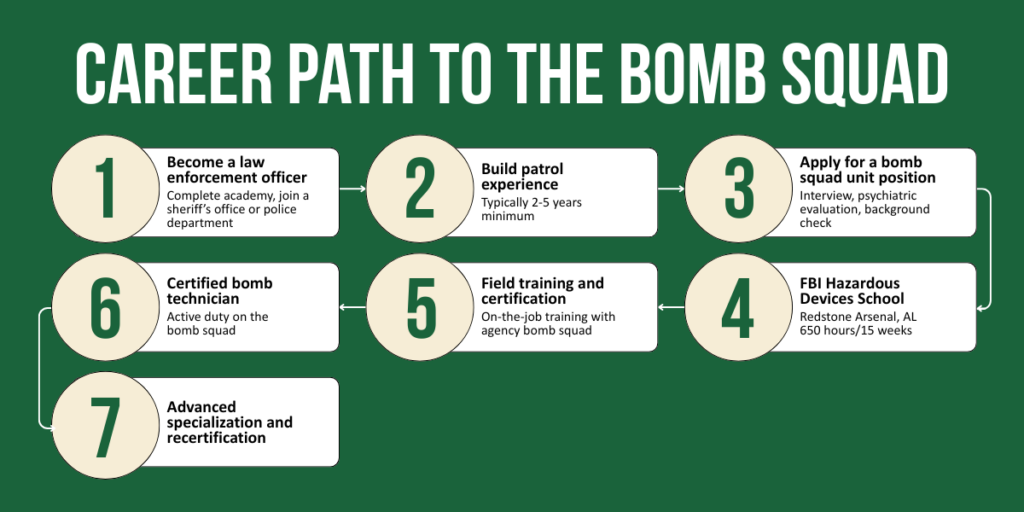
Before a Florida deputy or officer can be considered for a bomb squad position, they must first meet the foundational requirements of their agency. This typically includes Florida Department of Law Enforcement (FDLE) certification as a law enforcement officer, a minimum of two to five years of patrol experience, a clean disciplinary record, strong performance evaluations, and the ability to pass a psychological evaluation and enhanced background investigation.
Selection Process
Bomb squad positions in Florida are highly competitive and openings are rare. The selection process varies by agency but generally includes a formal application, interview panel, psychological evaluation, physical fitness assessment, and a thorough background check. Some agencies also require candidates to demonstrate mechanical aptitude and the ability to perform well under high-stress conditions.
FBI Hazardous Devices School (HDS)
The cornerstone of bomb technician training is the FBI Hazardous Devices School located at Redstone Arsenal in Huntsville, Alabama. This is the nationally recognized certification program that all public safety bomb technicians must complete. The program includes several key components.
- The basic course is approximately 650 hours, spanning roughly 15 weeks
- Curriculum covers explosive theory, safe disarming procedures, improvised explosive device recognition, post-blast investigation, and hazardous materials
- Upon successful completion, the technician receives national certification as a public safety bomb technician
- The course is open only to candidates who have been formally sponsored by their law enforcement agency
Recertification Requirements
Maintaining bomb technician certification is an ongoing commitment. Florida bomb technicians must meet the following recertification standards:
- Recertification through the FBI Hazardous Devices School is required every three years
- Technicians must complete a minimum number of in-service training hours annually to maintain proficiency
- K-9 explosive detection teams must recertify through an approved certifying body such as the ATF or Department of Homeland Security on an annual or biannual basis
- Failure to maintain certification can result in removal from the bomb squad
Advanced Training and Specializations
Once certified, Florida bomb technicians can pursue advanced training in a number of specialized areas including:
- Post-blast investigation and crime scene analysis
- Chemical, Biological, Radiological, Nuclear (CBRN) response
- Render-safe procedures for specific device types
- Tactical explosive threat response in support of SWAT operations
- Explosive detection K-9 handling
- Leadership and bomb squad supervision
Joint Training and Interoperability Exercises
Beyond formal certification and advanced specialty courses, bomb technicians regularly participate in large-scale training exercises designed to strengthen coordination with partner agencies. One example is the RC Interoperability Exercise, an annual international training event that brings together public safety bomb squads and military EOD units to improve their ability to respond to IED threats.
The exercise places participants in realistic operational scenarios that simulate the challenges of responding to explosive threats in complex environments. Training focuses on several key objectives:
- Exchanging tactics, techniques, and procedures between public safety bomb technicians and military EOD personnel to improve operational effectiveness.
- Strengthening partnerships and liaison relationships between public safety agencies and military organizations, ensuring seamless coordination during major incidents.
- Enhancing team integration by allowing personnel from different disciplines and jurisdictions to train and operate together.
- Employing dynamic live-fire training scenarios that replicate real-world threats and improve readiness under pressure.
- Providing leadership evaluation opportunities, allowing senior officials to observe operations in real time and assess decision-making processes used to mitigate potential IED campaigns.
Exercises such as RC help bomb technicians maintain proficiency, adapt to evolving threats, and develop the relationships necessary for successful multi-agency responses. The result is a stronger, more coordinated capability to protect first responders, critical infrastructure, and the communities they serve.
Spotlight on Florida Sheriffs’ Bomb Squad Units
Bomb squads across Florida operate in some of the country’s most complex and high-profile environments. The following examples highlight how these units serve their communities and the broader region.
Broward Sheriff’s Office
The Broward Sheriff’s Office Bomb Squad serves one of Florida’s most densely populated counties, providing coverage for Fort Lauderdale-Hollywood International Airport, the Port Everglades cruise terminal, and numerous large public venues. The unit maintains mutual aid agreements with neighboring agencies and regularly responds to calls across South Florida. Broward’s bomb technicians also play an active role in regional training and have participated in joint exercises with federal partners focused on mass-casualty event preparedness.
Marion County Sheriff’s Office
The Marion County Sheriff’s Office Bomb Squad is recognized as one of the more established regional bomb squads in Florida and serves as a Regional Response Team for the state. The unit provides coverage not only for Marion County, but also for neighboring counties including Levy and Putnam. Its technicians are trained at the FBI Hazardous Devices School and work closely with hazardous materials teams, allowing the squad to respond to explosive threats, suspicious packages, drug labs, and other high-risk incidents across a large rural region.
Bay County Sheriff’s Office
The Bay County Sheriff’s Office Bomb Squad is a federally accredited unit that serves as the primary bomb squad for Florida Domestic Security Task Force Region 1, covering 10 counties in Northwest Florida. Despite operating in a largely rural area, the squad maintains advanced capabilities including bomb robots, portable X-ray systems, containment vessels, and radiological detection equipment. Team members are FBI-certified bomb technicians and provide response support for explosive threats, suspicious devices, and large public events throughout the Florida Panhandle.
Community and Public Impact
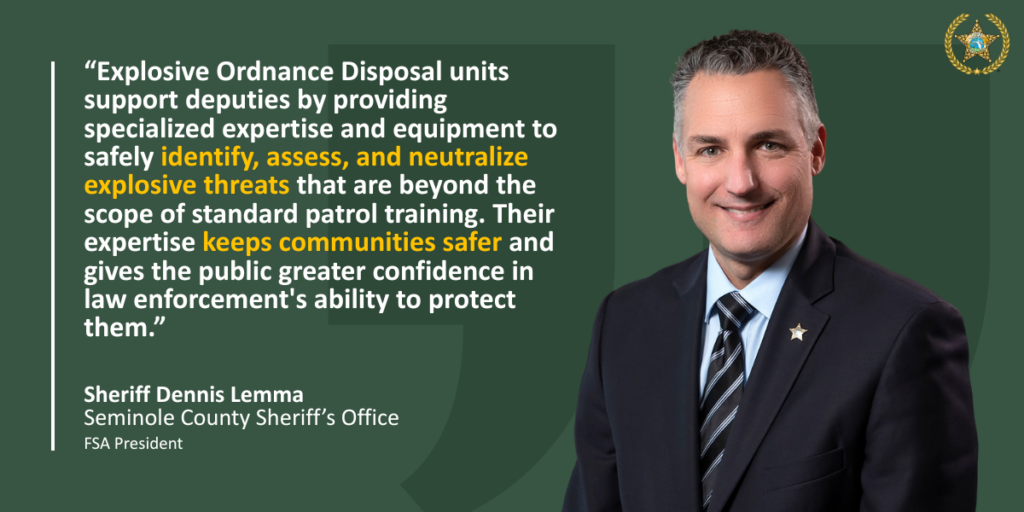
EOD units play a vital role in supporting law enforcement by providing specialized explosive response capabilities that ground deputies simply can’t match. From threat assessment and suspicious package evaluation to device disruption and post-blast investigation, these teams give agencies a critical “technical advantage” that improves safety, precision, and coordination in high-risk situations.
Many sheriffs’ offices in Florida operate with limited budgets, and acquiring costly equipment can be a challenge for smaller or rural agencies. To help address this, the Florida Sheriffs Association (FSA) operates a Shared Asset Program that provides funds to sheriffs’ offices to purchase equipment that can be shared regionally with neighboring agencies.
Supporting FSA means supporting every aspect of law enforcement across the state, including specialized units like aviation teams, K-9 squads, mounted patrols, and SWAT. Through programs like the Shared Asset Program, FSA helps sheriffs acquire critical equipment, advanced technology, and training that smaller offices might not be able to fund on their own. This support strengthens sheriffs’ ability to respond quickly to emergencies, conduct search and rescue missions, track suspects, and protect communities in every corner of Florida. When you support FSA, you’re helping ensure that law enforcement has the resources, training, and specialized units they need — making you, your family, and your community safer every day.
Frequently Asked Questions
Does every sheriff’s office have a bomb squad?
No. Maintaining a bomb squad requires significant resources, specialized equipment, and ongoing training. Smaller agencies typically rely on a neighboring county or regional bomb squad through mutual aid agreements.
What equipment does a bomb squad use?
Bomb squads use a range of specialized equipment including bomb disposal robots, X-ray imaging systems, Total Containment Vessels for transporting devices, bomb suits, disruptors, water cannons, and chemical detection tools. K-9 explosive detection teams are also a standard part of the response.
How dangerous is the job?
Bomb disposal is one of the most hazardous specializations in law enforcement. Technicians are trained extensively to mitigate risk, but the nature of the work involves direct exposure to explosive threats. Robots and remote tools are used whenever possible to reduce the need for a technician to physically approach a device.
Can civilians request a bomb squad response?
Yes. Anyone who encounters a suspicious device or receives a credible bomb threat should call 911 immediately. Dispatchers will assess the situation and activate the bomb squad if warranted. The public should never attempt to move, touch, or inspect a suspicious item.
Can a K-9 detect all types of explosives?
K-9s are trained to detect a wide range of explosive odors, including commercial, military, and improvised explosive compounds. No single K-9 is trained on every possible explosive, but most certified teams cover the most common and high-risk materials.
How long does it take to train an explosive detection K-9?
Initial explosive detection training typically takes several months following foundational obedience training. The handler and K-9 then train continuously together to maintain and sharpen the dog’s detection skills throughout the dog’s working career.
What happens when a K-9 alerts on a suspicious item?
When a K-9 alerts, the handler immediately notifies the bomb technician, who takes over the response. The area is secured, a safe perimeter is established, and the technician assesses and renders the device safe using specialized equipment.
Do K-9s replace bomb disposal robots or technicians?
No. K-9s, robots, and bomb technicians each serve a distinct role. K-9s are used for detection, robots are used for remote assessment and disruption, and technicians make the final determination and render-safe decision.
How long does it take to become a bomb technician?
The path typically takes five to eight years, including two to five years of patrol experience before being selected, followed by the FBI Hazardous Devices School — approximately 15 weeks — and additional field training with the agency’s bomb squad.
What is the FBI Hazardous Devices School?
The FBI Hazardous Devices School, located at Redstone Arsenal, is the national training and certification program for public safety bomb technicians. It is the standard all civilian bomb technicians must meet to be certified in the United States.
How often do bomb technicians need to recertify?
Bomb technicians are required to recertify every three years through the FBI Hazardous Devices School. Ongoing in-service training is also required to maintain proficiency between formal recertifications.
What is the salary range for a bomb technician?
Salary varies by agency, but bomb technicians typically receive a specialty pay differential on top of their base law enforcement salary.
About the Florida Sheriffs Association
Founded in 1893, the Florida Sheriffs Association was established to unite Florida’s sheriffs in advancing public safety, shaping legislation, and fostering collaboration among law enforcement agencies. Over the decades, FSA has grown into a powerful advocate for law enforcement, providing training, resources, and support to ensure the protection and security of Florida’s communities.
The Florida Sheriffs Association will help you to stay informed on the latest law enforcement initiatives, public safety updates, and the work of Florida’s sheriffs. From in-depth blogs to legislative news and community programs, we keep you connected to the issues that matter. Explore more at flsheriffs.org and stay engaged with Florida’s law enforcement community.